Pasta and lentil soup with kale and cabbage

A warm and comforting soup based on pasta e lenticchie, which is often made with just ditalini, but broken spaghetti or capellini, or pasta mista are also common. This recipe uses ditalini, but adds farfallini and fideo for variety. This is ‘soupier’ than the traditional dish and makes a small bowl for 4 or a larger bowl for 2. Double the pasta for something more traditional and filling or serve with fresh baked bread sticks as shown here.

Ingredients

For the pasta
6T semolina flour
1t plant-only egg replacer
2-3T lukewarm water

For the lentils
1 cup water, and 2T water, separated
1/2 cup brown lentils (black, green or dupuy will also work)
1 ‘sprig’ dried kombu, about 1″
2 scallions, minced, 3″ – 4″ green reserved for garnish
1/4t coarse sea salt
1T garlic
1/2t dried basil, rubbed
1/4t dried oregano, rubbed
1/4t dried thyme, rubbed
A pinch dried rosemary, rubbed
A pinch dried marjoram, rubbed
A pinch dried red chilis and/or 1/4t black pepper, freshly cracked
1T lemon juice
2 cups vegetable stock
2 cups tomato passata (or puree)
1 cup shredded green cabbage
1 cup green curly kale, coarsely chopped
1/4 cup nutritional yeast
2T fresh basil, chopped finely or chiffonade
Coarse sea salt and black pepper to taste

Optional: Add a teaspoon coconut sugar (or similar) if you like with the other herbs for a little more balanced flavour. Spinach would be more traditional than cabbage and kale, but chard would also make a nice alternative. Saute the scallions, et al., in a little cooking oil instead of water, or finish the dish with a little drizzled olive oil for a richer taste and mouthfeel. Replace the lentils with chickpeas or white beans.

Method

Start the lentils, then make the pasta.

In a large frying pan with a lid, bring 1 cup water to a light simmer. Add the lentils and kombu. Cover, simmer for 30 minutes until they are fully cooked but still al dente.

While the lentils simmer, combine the dry ingredients for the pasta, add the water and knead until you have a smooth, elastic dough. If you knead for 2 – 3 minutes and the dough is still a bit dry, add more water, 1 teaspoon at a time, but give it a few minutes. When smooth, cover with a warm wet tea towel and let rest about 15 minutes.

When the dough has rested, prepare and cut the pasta shapes you’d like. See the notes below on how to make the particular shapes. Your lentils should be about ready by the time you are finished with the pasta. Drain, reserving the kombu. Set the lentils and kombu aside.

Warm the pan on medium heat. Add the 2T water, scallion, garlic and herbs. Stir fry for about 2-3 minutes. Add the cabbage and stir fry for another 3 – 5 minutes. Add the lemon and deglaze the pan. Add the stock and 1 cup passata. Return the lentils to the pan.

Return the pan to a light simmer, reduce heat to medium low and simmer 10 minutes. Remove the kombu. Add the kale and stir to combine. Return the pan to a light boil.

Add the farfallini and ditalini and simmer 3 – 4 minutes. Wait a minute or two before adding the fideo. Add the remaining passata and return the pan to a simmer. Simmer another 5 minutes or so until the pasta is done. Remove from heat.

Add the nutritional yeast and stir to combine. Season to taste. To plate, ladle out and garnish with scallion green sliced on an angle, basil, and some additional nutritional yeast if you like and serve.

Making the pasta
Any or all of these shapes will go well in this dish. I also use ricciolini from time to time. Toast or fry the fideo if you like. You can also use boxed pasta, but you may want to parboil separately depending on what you use.

For farfallini, roll out the a large rectangle about 1/8″ thick. Cut 3/4″ x 1/3″ rectangles (smaller if you can). The ends of farfallini are often rounded, but rectangles will be much easier. Working quickly, pinch each strip firmly in the middle with the edges of your thumbs. If you want to make them even smaller, you can always try a pair of tweezers. Let dry on the board.

For ditalini, you’ll either require a dowel or something similar (something long, round and needle-like, but even in diameter). Roll the dough out to about 1/6″ and cut into 4″ x 1/2″ strips. Wrap the dough width-wise around the dowel and pinch closed (so that you have a long, 4″ tube).

Roll gently on the cutting board to create long, even tubes, about 1/3″ in diameter. Slide off the dowel and repeat. If your dowel/dowel replacement is long enough, do longer pieces of dough. Let each dry on the board.

For fideo, some people simply use broken spaghetti, although traditionally, fideo is actually a Spanish noodle and has a slight curve. If you have a lot of experience with chiffonade or julienne, this won’t be a difficult shape.

Roll the dough into a rectangle about 1/8″ thick (thinner if you can). Cut into long rectangular strips about 1 1/2″ high by several inches long. Carefully and precisely cut 1/8″ strips. Roll each strip gently with a few fingers to round it. Either curve each strip a little and let dry on the board, or gently arrange on a curved glass and let dry there.

When ready, add to the soup as directed

Twice-dressed roasted vegetable, spinach salad

Potatoes, cubanelle peppers, mushrooms, and pears roasted with scallions, chili and garlic, tossed with sundried tomatoes, nutritional yeast and flax, then tossed with baby spinach in a sesame and tamari balsamic vinaigrette.

Ingredients

For the roasted vegetables
2 cups potatoes, 1/2″ dice (I use white grelots and quarter them)
2 cubanelle peppers, cored and seed, sliced 1/4″ length-wise
1/4 cup scallions, finely chopped
1T fresh garlic, minced
1/4t coarse sea salt
1/4t dried red chilis (or to taste)
1t herbes de Provence (or similar)
2 cups cremini mushrooms, stemmed and quartered
2 bartlett pears, cored, sliced 1/4″ length-wise
1/2T lemon juice
1/4 cup sundried tomatoes rehydrated with 1/4 cup boiling water (use dehydrated, not jarred)
1/4 cup nutritional yeast
1T milled flax seed
Coarse sea salt and black pepper to taste

For the spinach
1/2T sesame seed butter
1/2t fresh garlic, minced
1/4t coarse sea salt
1/2T balsamic vinegar
1/2T tamari
1/2t prepared brown mustard
2T water
3 cups loose baby spinach
Coarse sea salt and black pepper to taste

Method

Preheat the oven to 400F. Toss the ingredients for the roasted vegetables up to and including the lemon juice. Bake on a lightly oiled or nonstick baking sheet on the middle rack for 45 minutes to 1 hour, until the vegetables are lightly browned and the potatoes are fork tender. Ovens vary; use the texture and colour as a guide.

Around the 40 minute mark, rehydrate the tomatoes and set side. When the vegetables are done, remove from heat, pour the tomatoes and their soaking water over the roasted vegetables. Let stand while you prepare the spinach.

Whisk together the dressing for the spinach adding the ingredients in order. Mix until emulsified (shouldn’t take more than a minute or so). Dress the spinach. Season to taste.

Add the flax seed and nutritional yeast to the roasted vegetables and toss to combine. Season to taste. Toss the roasted vegetables with the spinach, let stand 2 – 3 minutes to wilt the spinach, and then serve.

Curry-spiced potatoes, cabbage and poblano peppers with lightly breaded tofu

This is a rich, comforting dish, simmered in stock and curry spices, stir fried with lightly breaded tofu, then finished with sesame cream, diced tomato, and scallions,

Ingredients

For the potatoes
1T curry powder
1/4 cup scallions, finely chopped, 3″ – 4″ green reserved for garnish
1/2T fresh garlic, minced
1/2t fresh ginger, grated and minced
2 cups shredded green cabbage (I use coleslaw mix)
1 poblano pepper, cored and seeded, 1/4″ dice
1/4t coarse sea salt
1 1/2 cups white grelot potatoes, quartered (or similar)
1 cup vegetable stock
1/2 cup unsweetened plant milk (I use soy)
Coarse sea salt and black pepper to taste

For the tofu
225g extra firm, high quality tofu, 1/3″ cubes
1T corn starch
1/4t coarse sea salt
A good pinch black pepper, freshly cracked

For the garnish
1/2T sesame seed butter
1/2t lemon juice
1T cold water
A pinch sea salt
1/4 cup tomato, seeded cored, 1/4″ dice (roma preferred, but any red should do)
Scallion green sliced on an angle

Optional: Use freshly ground/popped spices in place of the curry powder if you prefer. Add colour with some diced red pepper. Add colour and some additional heat with a little sriracha. Press your tofu ahead of time if necessary. Add some dried kombu to the stock if you like. Fry the tofu instead of baking and add on top at the end and/or use wheat flour for the tofu if you prefer, but the breading mostly serves the purpose of providing cling for the sauce.

Method

Preheat the oven to 400F. Warm a large frying pan with a lid on medium heat. Add the curry powder and toast for 1 minute. Add the scallions, garlic and ginger. Saute for 2 minutes. Increase heat to medium high. Add the cabbage, poblano pepper, and sea salt. Saute for 3 minutes.

Add the potatoes and stir to combine. Saute another minute or so. Add the vegetable stock and deglaze the pan (if necessary). Cover, reduce heat to low and simmer for 15 minutes, or until the the stock has been absorbed/reduced and the potatoes are fork tender.

Mix the cornstarch, black pepper and sea salt for the tofu. Toss the tofu in the mixture until well coated. Add a little unsweetened soy milk if you find the cornstarch mixture won’t cling.

On a baking sheet or roasting pan, bake the tofu for 15 minutes, turning periodically to ensure even crisping. Remove from the oven and set aside if necessary until the potatoes are done.

When the potatoes are ready, uncover the pan and increase the heat to medium high. Add the tofu and stir fry for 3 minutes. Add 1/2 cup soy milk and stir to combine. Saute another 2 minutes. Remove from heat and set aside.

Whisk together the sesame seed butter, lemon juice, water, and sea salt until smooth and creamy. Add water 1/2 teaspoon at a time to get the right texture if you need to. Spoon out the potatoes and tofu. Drip the sesame cream over the mixture. Garnish with tomato and scallion, and serve.

Dark chocolate, chocolate chip cookie dough nice cream

Dark chocolate, chocolate chip cookie dough nice cream

Simple and satisfying.

Ingredients

For the cookie dough
1 1/2T cashew butter
1T whole wheat flour
2t cocoa powder (I use a fairly traded Dutch process brand)
1 1/2T coconut sugar
A pinch coarse sea salt
1-3t unsweetened plant milk (I use soy)
5g bittersweet chocolate, chipped (I use an organic, fairly traded bar)
Sweetener to taste

For the bananas
2 medium frozen bananas (about 2 cups)
1/2t vanilla extract
Sweetener to taste

Optional: 1t powdered maca root. Trade the wheat flour for an appropriate gluten free flour (e.g., sorghum). The coconut sugar crystals give the right texture, but other sweeteners will work. You can also use a few prepackaged chocolate chips.

Method

Combine the cashew butter, flour, salt, sugar,and cocoa until crumbly. Add the plant milk starting with 2t until a smooth dough forms. If too dry, add plant milk one teaspoon at at time until you have a smooth dough (it shouldn’t require more than 3t). Mix in the chipped chocolate. Set aside.

Blend the bananas with the vanilla until smooth. Sweeten to taste (if necessary) with dates, maple syrup, agave nectar or stevia. Add 1T cookie dough and blend with the bananas for a more consistent flavour; leave them separate for more contrast. Break the cookie dough into 1/2 – 1t sized bites, add to the bananas and stir once or twice to distribute. Spoon out and serve!

Tacos with spicy tempeh, white miso sauce and baby greens

Tacos with spicy tempeh, white miso sauce and baby greens

Soft, hand rolled corn tortillas, warm spicy tempeh and lime accented greens make this a lovely and flavourful dish. Fresh tortillas are terrific and when you make them from scratch, you control all of the ingredients. Be sure to use masa harina rather than regular corn flour
for this recipe. This makes eight small tacos.

Ingredients

For the tempeh
1T cooking oil
1T fresh garlic, minced
1T red Thai chili paste (or similar and/or to taste)
250g tempeh, crumbled (use pasteurized)
1/4 cup tamari (or to taste)
1 cup vegetable stock
1/4t coarse sea salt

For the tortillas
1 1/2 cups masa harina
1/2T ground flax seed
1/2t coarse sea salt
1 cup hot water

For the white sauce
1 cup unsweetened plant milk (I use soy)
1/4t coarse sea salt
1T white vinegar
1T sesame seed butter
1T white miso
2T tapioca flour dissolved in 2T cold water
Sea salt and black pepper to taste

For the greens
1T olive oil
1t lime juice
1/4t coarse sea salt
1T nutritional yeast
1 cup loose baby kale
1 cup loose baby spinach

For the garnish
1/2 cup passata (or tomato puree)
1/2t red Thai chili paste (or similar and/or to taste)
Coarse sea salt and black pepper to taste.
2T nutritional yeast

Method

First, start the tempeh, then the tortillas, the white sauce, the greens and the garnish.

In a frying pan with a lid, bring the oil and sea salt to heat on medium high. Add the garlic and chili and fry for 2 minutes. Add the tempeh and fry for 3-5 minutes. Add the tamari and deglaze the pan.
Add the stock, cover, reduce heat to low and simmer for 45 minutes.

While the tempeh simmers, make the tortillas. Mix the dry ingredients and add the water. Stir to form a smooth, pliable dough, neither too dry nor moist. If the dough is too wet, add more masa 1T at at time; if too dry, add water 1T at a time. Divide the dough into 8 equal parts, and flatten each into a 2-3″ round disk. Cover the dough with a damp cloth while you press the tortillas.

Heat a frying pan on medium high heat. If you have a tortilla press, follow the instructions provided.
If you don’t, roll the tortillas out gently between two sheets of plastic wrap into rough circles about 1/8″ thick, about 5-6″ in diameter. It’s the peeling of the tortilla that’s of the most difficult part — go slowly. Carefully peel and add the tortilla and cook until the top of the tortilla is start to look dry. Flip and cook the other side (it should be about 1 minute each side, a little more on the first, a little less on the second).Little brown spots make a tortilla look lovely. Repeat for the remaining 7 tortillas and cover with a warm, very lightly damp tea towel.

Let the tortillas rest for about 20 minutes to cool and soften until you’re ready to use. The tortillas will keep, but you’ll likely have to steam them to use them later. At the 40 minute mark, preheat the oven to 450F. In a shallow pan with sides, bake the tempeh for another 20 minutes or until the moisture has been absorbed the tempeh has started to brown. Ovens vary; use the colour as your guide. Don’t overcook.

Start the white sauce and broil the tempeh for another 5 minutes. In a small sauce pan, bring the soy milk to a simmer. Add the sea salt, miso, sesame seed butter and vinegar. Stir to combine and simmer for 5 minutes uncovered. Slowly add the tapioca solution stirring continuously until it thickens.
Remove from heat and season to taste. Remove the tempeh from the oven. Let the white sauce and the tempeh cool for a few minutes.

While they cool, whisk the dressing for the greens and toss. Whisk the ingredients for the garnish.
To assemble, fill each tortilla with 3-4T tempeh, 2T white sauce, 1/4 cup greens and then about 2t passata mixture. Sprinkle with nutritional yeast and serve.

Black lentil mezzaluna in a sesame white sauce with oyster mushrooms and kale

Black lentil mezzaluna in a sesame white sauce with oyster mushrooms and kale

Similar to pierogi, mezzaluna are a lovely and decorative pasta, filled here with a lightly spicy combination of black beluga lentils, poblano peppers and Brussels sprouts, served in and a rich sauce of white miso, sesame seed butter and oyster mushrooms. This makes an appetizer portion for 4 or large plate for 2.

Ingredients

For the filling
1/4 cups black lentils
2/3 cups water
1 ‘sprig’ dried kombu (about 1/2″)
1T cooking oil
1/4t coarse sea salt
1 scallion, minced (3″ – 4″ green reserved for garnish)
1/4 cup poblano pepper, chopped finely
2 Brussels sprouts (about 1/4 cup scant), minced (or green cabbage)
Coarse sea salt and black pepper to taste
For the dough
1 cup semolina flour
A pinch sea salt
1/3 cup water
1t olive oil
2 liters water and 2t coarse sea salt for boiling
For the sauce
1T cooking oil
1/4t coarse sea salt
1/2t dried basil, rubbed
1/4t dried oregano, rubbed
1T fresh garlic, minced
1/4 cup oyster mushroom, wiped and finely chopped
1/2T lemon juice
1 cup unsweetened plant milk
1T sesame seed butter (I use a fairly traded brand)
1 cup green curly kale, finely chopped
1T arrowroot flour dissolved in 1T cold water
1/2T white miso
2T nutritional yeast
Coarse sea salt and black pepper to taste

Optional: Replace the Brussel sprouts with sun-dried tomatoes for something slightly more flavourful.

Method

Start the filling first, then the pasta, then the sauce. In a small pan with a lid, bring the water to a boil. Add the lentils. Reduce heat to low, cover and simmer for about 30-40 minutes or until the water is absorbed and the lentils are tender. When the lentils are done, remove the kombu, rinse the lentils and set aside.

While the lentils simmer, make the pasta dough. Mix the flour and salt. Mix the water and oil. Mix the wet and the dry. The dough may seem too dry initially. Keep mixing, and then knead until as a smooth elastic dough forms, and then another 2-3 minutes. Cover with a warm wet tea towel and set aside to rest for at least 30 minutes.

When the lentils are ready, in a medium frying pan, bring the oil to eat on medium high. Add the cooking oil and sea salt. Add the scallion. Saute for 2 minutes. Add the pepper and Brussels sprouts and saute for 5 minutes. Add the lentils and stir to combine. Remove from heat. Set aside covered to cool.

Roll out the dough on a floured board in a large rectangle about 1/10″ thin. Cut small circles about 2 1/2″ round. Bunch up leftover dough, roll out and cut. Repeat until all of the dough has been used. Aim for 16 circles.

When the dough has been cut, add a heaping tablespoon of filling to each in an oblong shape in the middle. Carefully pinch closed, starting with the top, one side, and then the other. Squeeze out any excess air. Crimp both sides of the seam with a fork. Let sit to dry lightly while you make the sauce.

In a large pan with a lid, bring the cooking oil and sea salt to heat with the sea salt on medium high. Add the green herbs and saute for 1 minute. Add the garlic and saute for 1 minute. Add the oyster mushrooms and saute for 2 minutes. Add the lemon juice and deglaze the pan. Add the soy milk. Bring the pan to a light simmer. Add the sesame seed butter and stir to dissolve. Simmer lightly, stirring occasionally while you finish the pasta.

In a large pot, bring the 2 liters water to a boil with the sea salt. Add the mezzaluna carefully to the water and boil lightly until they float (should be 3-5 minutes). They’ll float when done. Don’t overcook. Drain them carefully in a colander, reserving 2T of the pasta water. Rinse the pasta gently with cool water.

Add the pasta water and the kale to the sauce and stir to combine. Simmer another 2 minutes. Stirring continuously, add the arrowroot mixture until it thickens. Remove from heat. Add the white miso and stir until dissolved. Rinse the mezzaluna with hot water, drain and add them to the sauce. Stir gently to coat. Let stand 2-3 minutes to cool. Season to taste.

When lightly cooled, plate the mezzaluna and pour sauce over them. Add the scallion greens sliced on an angle. Dust with nutritional yeast, and serve.

Miso noodle soup with kale and mushrooms

Miso noodle soup with kale and mushrooms

Simple and satisfying with nourishing miso and chewy noodles simmered in the broth. This recipe easily doubles.

Ingredients

For the soup
2T water
1/4t coarse sea salt
1 scallion, minced (2″ – 3″ green reserved for garnish)
75g cremini mushrooms, 1/4″ slices
1/2T lemon juice
1/2T tamari
2 cups water
1 ‘sprig’ dried kombu (about 1″)
1-2T red soy miso (to taste)
1 cup green kale, coarsely chopped
Coarse sea salt (or tamari) and black pepper to taste

For the noodles
1/4 cup whole wheat bread flour
2-3T cold water
A pinch sea salt

Optional: Additional sea vegetables will go well in this soup, as would sesame seeds for garnish. Replace the cremini mushrooms with shiitake mushrooms if you prefer. Use white miso or just 1T red miso for something a little more neutral in taste. Add a few drops of toasted sesame oil with the scallions for a little additional flavour.

Method

Make the noodles first, then the soup. Mix the flour, salt and water together until a smooth dough forms. If you need to add extra water, do so a teaspoon at a time. Knead for 3 minutes and set aside in a bowl covered with a warm, moist tea towel. Let rest for at least 10 minutes. Knead another 3 minutes. Return to the bowl for another 10 minutes to rest. Knead another 3 minutes. Return to the bowl for a final 10 minutes.

On a floured board, roll the dough out to a large rectangle, about 1/8″ thick and no less than 9″ long. Using a wheeled pastry cutter, cut 1/4″ noodles, or fold very gently length-wise into thirds (in an S-curve) and cut the noodles with a knife if you prefer. Let the noodles rest while you make the soup.
Bring a large pan with a lid to heat on medium high. Add the water, sea salt, scallions, and mushrooms. Stir fry for 3-5 minutes, or until the pan is starting to brown and the mushrooms are softening. Add the lemon and tamari and deglaze the pan. Stir fry another 2 minutes. Add the water and kombu, and return the pan to a simmer. Simmer uncovered for 10 minutes.

At the 10 minute mark, add the noodles and simmer for 2 minutes. Add the kale and simmer another two minutes. Remove from heat and let stand 2 minutes to cool. Add the miso and stir to combine. Season to taste. Ladle out, garnish with scallions sliced on an angle, and serve.

Peanut butter, chocolate chip cookies with ginger and molasses

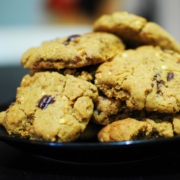
Peanut butter, chocolate chip cookies with ginger and molasses

The ginger and molasses add a little flavour nuance to this rich, flaky cookie. This makes about a dozen larger cookies, up to two dozen small ones.

Ingredients

1/2 cup unsweetened, unsalted peanut butter (I use crunchy)
1/3 cup coconut oil
1T cold water
1/4t coarse sea salt
1/2 cup turbinado sugar (or more to taste if you have a sweet tooth)
1t blackstrap molasses
1/2t fresh ginger, grated and minced (or more to taste — I use 1t)
1/2 cup all purpose, unbleached flour
2/3 cup whole wheat flour (I use bread flour)
1/4 cup unsweetened plant milk
25g bittersweet chocolate, chipped (I use a fairly traded, organic brand)

Optional: Use ready-made chocolate chips you prefer. You can make smaller cookies, use pastry flour instead of bread flour, use all whole wheat flour, change the sweetener, trade the coconut oil and water for plant-only margarine, add flax or banana for some additional binder, or make an all peanut butter version, but this will affect the overall chemistry. You may have to change the liquid balance and/or the bake time.

Method

Preheat the oven to 350F. Cream the peanut butter with everything up to and including the ginger. Mix the flours and stir the combination into the peanut butter. Stir in the plant milk. Add the chipped chocolate to the dough, reserving about 1/3 to add to the cookies once pressed.

On a baking sheet lined with parchment paper, add the dough in about 2 tablespoon sizes. Press a little of the remaining chocolate into each cookie. Press each cookie lightly with a fork to crosshatch so that each is no more than 1/2″ high.

Bake on the middle rack for 12-15 minutes, shorter for softer cookies, longer for crunchier cookies, depending on your oven. Be careful not to overbake. Ovens vary; use the colour and texture of the cookie as a guide to bake time (they should be lightly browning at the tips for soft cookies).

Remove from the oven and cool on a wire frame for about 30 – 45 minutes for still warm, soft cookies, or cool for an hour or so, cover, and serve later.

Freshly baked garlic, herb bagels

Freshly baked garlic, herb bagels

Although it’s the extreme dry heat of a professional oven that makes the absolute best bagels, it’s possible to make a good bagel at home. Many bagels made at corner shops are made with egg wash, honey, or other ingredients. Commercial bagels are often made with micro-ingredients, such as l-cysteine, and they lack the satisfying chew of a freshly baked bagel. This recipe makes half a dozen, but easily shrinks or doubles.

Ingredients

3 cups whole wheat bread flour
A pinch coarse sea salt
1 1/2 – 2 cups warm water
1 1/2T yeast
1/2T green herbs (I use herbes de Provence)
1/2t garlic powder
2 liter water
1T baking soda
1T blackstrap molasses
2T unsweetened plant milk

Optional: There are a lot of variations for bagels. You can braid the dough for something more European. You can make them smaller with a larger hole and sprinkle them sesame seeds for a bagel in the Montreal style. You can also flavour your bagels as you like (e.g., with onion or cinnamon and raising, etc.), but be careful of interrupting the yeast.

For a plain bagel, leave out the garlic and herbs. Unbleached, all purpose flour will give you a bit more fluff (but you made need less water). You can also sprinkle sesame seeds and other toppings toward the end of the baking. You can also change the sweetener, but be careful about changing the pH balance of the water too much — it’s partly what makes the bagel chewy.

Method

Note, to get the fluffiest, chewiest bagels you can, it’s helpful to have a baking stone for this recipe. If you don’t have one, sprinkle a lightly oiled baking sheet with 1/2T coarse yellow corn meal instead. Or, if you have baking paper rated to 450F, use that. You want a hot, dry oven.

It’s also best if you have a pan large enough to boil them all at once. The longer the bagels sit between the boiling and the baking, the longer they lose their heat and the fluff that goes with it. If you have to do the boiling in batches, remove each to a clean, dry cutting board sprinkled with a little corn meal while you do the remainder.

Start by mixing the flour and salt. Mix the water and yeast according to its instructions. Add the wet to the dry and mix until a smooth dough forms. Add additional water as necessary 1 tablespoon at a time. Knead for about 10 minutes. Let the dough rise covered with a warm, moist tea towel for 2 hours, punching down periodically. Roll out on a floured board. Fold in the garlic powder and herbs. Knead for a minute or so.

When the dough is ready, break into 6 equal parts. If you want large, sandwiched sized bagels, break the dough into 4 parts. Roll the dough out to a long thing tube, about 6″ long and 1 1/2″ in diameter, between your palms.

Once rolled, connect both ends of the tube securely into a bagel shape. The size of the hole varies by style. I make mine about 1 1/2″, and I twirl it on my index finger. Repeat until all your bagels are ready. Cover and let rise another 30 minutes or so. Don’t let them over-rise.

In a large pan, bring the water to a light boil. Preheat your oven to 500F (or 450F if your oven doesn’t reach 500F). Add the baking soda and molasses to the water and return to a light boil. Add the bagels, simmering them in the mixture for about 1 minute, turning over and boiling another 30 seconds or so. Remove the bagels from the water with a slotted spoon.

Add your bagels to your baking stone or sheet. Bake for 10 – 15 minutes until they are starting to brown lightly (depending on the temperature and whether you use a stone, a baking sheet, etc.). Ovens vary; use the colour and texture of your bagel as a guide.

When the bagels are starting to lightly brown, brush each with a little plant milk. Sprinkle any additional toppings at this point. Bake for another 2-3 minutes. Remove from heat. Let cool on a wire rack for 30 minutes to an hour before serving. Or, let cool completely and then package up for later.

Black lentil and amaranth soup with sesame and roasted kale

Black lentil and amaranth soup with sesame and roasted kale

Warm and satisfying, and with the amaranth, a fairly nutrient dense soup. This make a large bowl for 1, small bowls for 2, and easily doubles.

Ingredients

For the soup
3T dried black beluga lentils
3T dried amaranth
2 cups water
1 ‘spring’ kombu (about 1/2″)
1 scallion, minced (1t set aside for garnish)
1T fresh garlic, minced (1/4t reserved for garnish)
1/2t fresh ginger, grated and minced
3T tomato passata (or puree)
1t sriracha
1t prepared brown mustard
1t balsamic vinegar
1/4t black pepper, freshly cracked (or to taste)
1/4t blackstrap molasses
1/2T green herbs (I used herbes de Provence)
Coarse sea salt and black pepper to taste

For the kale
1 cup green curly kale, chopped
1t scallion (as noted above)
A pinch coarse sea salt
Sea salt and black pepper to taste

For the sesame ribbon
1t sesame seed butter
1/2t lemon juice
1/4t fresh garlic, minced (as noted above)
A pinch coarse sea salt
1t cold water

Optional: Add a tablespoon nutritional yeast to the kale after roasting for some additional flavor and nutrition.

Method

In a medium pan with a lid, bring the water to a light simmer. Add the black lentils and kombu. Reduce heat to low, cover and simmer. At the 10 minute mark, add the amaranth.

Simmer until the amaranth has dissolved into the soup (about 20 – 30 minutes). Remove the kombu. Add the remainder of the ingredients for the soup. Stir to combine. Return to a simmer, reduce heat to low, cover, and simmer another 15 minutes.

Preheat the oven to 450F. Toss the kale with the scallion, garlic and sea salt. Roast in a thin layer on a baking sheet or roasting pan for 6-10 minutes until the kale is lightly wilted and a vibrant green. Ovens vary; use the colour and texture of the kale as a guide. When done, remove from heat and set aside.

Whisk together the ingredients for the sesame ribbon in order until the sesame becomes a little fluffy. Set aside until the soup is done.

When everything is ready, season the soup and the kale to taste. Ladle out. Pour the sesame ribbon out in the design of your choice. Add the kale in the center, and serve.